Multiply Logo
Multiply Logo

MULTIPLY (Multilayer Predictive Models for Relapsed MCL after Ibrutinib as First-Line Therapy) is a study designed to validate clinical and biological biomarkers of prognosis (e.g., Mantle Cell Lymphoma International Prognostic Indexes such as MIPI and MIPI-c) and to characterize first-line therapy in mantle cell lymphoma through predictive modeling approaches.
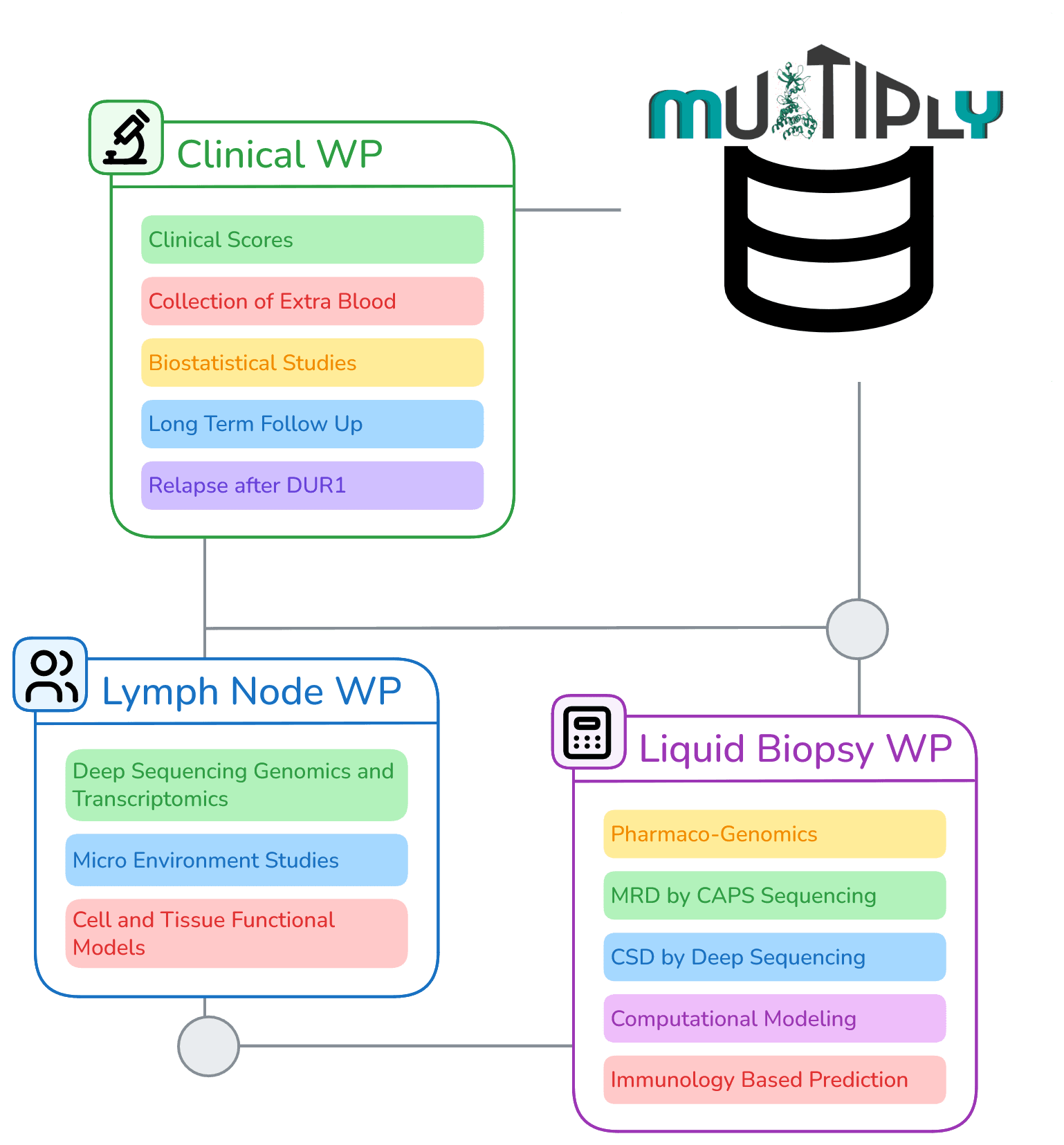
Multiply Database Simplified ER Diagram

MULTIPLY is structured into three major interconnected work packages (WP).

Clinical WP

Identification of clinical predictors, characterization of relapses and salvage treatment.

  1. Validate clinical and molecular predictors.
  2. Analyze long term toxicities, including secondary malignancies.
  3. Implement a long-term follow up after the closure of clinical trial.
  4. Analyze the impact of the order of subsequent treatment lines on survival.
  5. Analyze re-exposure to a BTK-inhibitor after Ibrutinib treatment.
  6. Implement a database for the collection of subsequent tissue biopsies.
  7. Identify molecular and clinical prognostic factors at relapse.
  8. Provide a clinical control data set of relapsed MCL.
  9. Support WP II and WP III in terms of provision of clinical data.
  10. Integrate data obtained in all WPs for generating prognostic models.

Lymph Node WP

Identification of lymph node-derived predictors.

  1. Implement a Digital Pathology Hub for rapid review/biomarker scoring.
  2. Apply deep learning tools to WSI of MCL and pathology, molecular and clinical data for relapse prediction.
  3. Perform NGS genetic/transcriptomic characterization to identify high-risk factors of treatment failure.
  4. Study early-relapse MCL microenvironment characterizing the tumor, immune cells spatial organization and gene expression.
  5. Derive new PDX in immunodeficient NSG mice to test treatments or biomarker-driven strategies.

Liquid Biopsy WP

Evaluation of biological predictors based on PB, BM, and cfDNA.

  1. Identify and validate non-invasive baseline predictors of primary refractoriness
  2. Develop novel monitoring approaches able to capture early signs of clonal evolution and disease progression during and after the treatment
Blood Cancer United LogoEuropean MCL Network Logo

The presented data reflects information collected up to the year 2024.